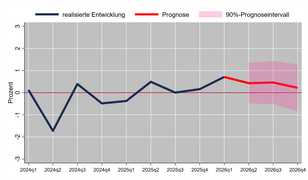
According to the latest nowcast by the Institute for Applied Economic Research (IAW) and the University of Hohenheim, Baden-Württemberg’s gross domestic product is set to rise by 0.4 per cent in the second quarter of 2026 compared with the previous quarter, adjusted for seasonal and working-day effects. Positive growth is also forecast for the following two quarters, although this is expected to slow towards the end of the year.
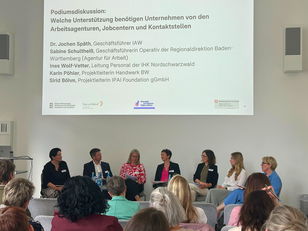
Ninth joint workshop organised by the ‘Women and Work’ contact points and the equal opportunities officers for the labour market. Stuttgart, Haus der Wirtschaft.
Keynote presentation:
Women’s employment in Baden-Württemberg – The role of work-life balance measures. A study based on the IAB Baden-Württemberg Firm Panel.
What support do businesses need from employment agencies, job centres and contact points?
Themed discussion in a World Café format:
Work-life balance in small businesses – what are the obstacles, and what helps?
3rd IAW Workshop on Growth, Prosperity and Democracy in Stuttgart.
This workshop took place on 12 June and focused in particular on the following questions:
Is it necessary to rebalance the relationship between the state, civil society and private-sector actors in order to achieve welfare state objectives even during a period of zero growth?
How can the emergence of communicative power and its institutional translation into administrative power be secured under the changed conditions?
How can the changed conditions for action be translated into an informed public discourse with the potential for rational policy decisions?
The results of this workshop will be published in 2027 as the third volume in the series ‘Growth. Prosperity. Democracy’.
May 7, 2026: 11th Bundesbank-IAW Lecture at the University of Tübingen.
The Deutsche Bundesbank’s headquarters in Baden-Württemberg and the Institute for Applied Economic Research (IAW) invite you to the “Bundesbank-IAW Lecture” on Thursday, May 7, 2026, at 4:15 p.m. in the Neue Aula at the University of Tübingen.
We are very pleased to welcome Prof. Dr. mult. Dr. h.c. Ulrike Malmendier from the University of California, Berkeley. Her lecture is titled:
Human Finance – Incorporating Insights from the Life Sciences into Finance, with an Application to German Capital Markets and Pension Reform.
Please refer to the invitation for further information. Registration to attend the lecture is not required.
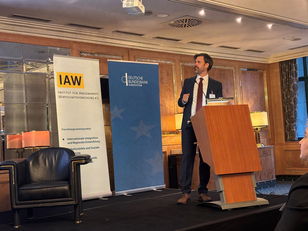
How should Europe position itself to address the increasingly pressing challenges posed by global economic upheavals, geopolitical tensions, and potential crises in the international financial system? Prof. Dr. Christoph Trebesch, Vice President of the Kiel Institute for the World Economy and a world-renowned expert in the field of geoeconomics, addressed this question at this year’s lecture event hosted by the IAW and the headquarters of the Deutsche Bundesbank in Baden-Württemberg on March 26, 2026.
The event also featured the presentation of the 2026 Norbert Kloten Prize for the best theses in the field of applied economic research at the Universities of Hohenheim, Stuttgart, and Tübingen. This year’s prizes went to Judith Lehner from the University of Tübingen and Ricardo Acevedo Arias from the University of Hohenheim.
More women in employment – structural barriers remain.
The IAW today presented a new report (in German) on gender-specific employment trends in the state, commissioned by the Baden-Württemberg Ministry of Economic Affairs, Labour and Tourism (title: “Employment trends and recruitment practices in Baden-Württemberg. A gender-specific analysis based on the IAB Establishment Panel"). The report shows that female employment in Baden-Württemberg has developed positively in recent years. At the same time, structural differences between women and men persist in the labour market.