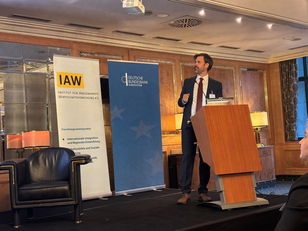
How should Europe position itself to address the increasingly pressing challenges posed by global economic upheavals, geopolitical tensions, and potential crises in the international financial system? Prof. Dr. Christoph Trebesch, Vice President of the Kiel Institute for the World Economy and a world-renowned expert in the field of geoeconomics, addressed this question at this year’s lecture event hosted by the IAW and the headquarters of the Deutsche Bundesbank in Baden-Württemberg on March 26, 2026.
The event also featured the presentation of the 2026 Norbert Kloten Prize for the best theses in the field of applied economic research at the Universities of Hohenheim, Stuttgart, and Tübingen. This year’s prizes went to Judith Lehner from the University of Tübingen and Ricardo Acevedo Arias from the University of Hohenheim.
For the 10th anniversary of the Bundesbank-IAW Lecture at the University of Tübingen, organized annually by the IAW in cooperation with the Bundesbank's Baden-Württemberg headquarters, a very special speaker was invited: Dr. Joachim Nagel, acting president of the Deutsche Bundesbank and thus head of the institution whose name the renowned lecture series bears. The lecture, held in English, took place in the almost full Audimax lecture hall at the University of Tübingen. In his speech, Dr. Nagel provided a detailed overview of the European Central Bank's monetary policy strategy since 2021 and answered numerous questions from the audience.
The Deutsche Bundesbank, Head Office Stuttgart, and the Institute for Applied Economic Research e.V. (IAW) cordially invite you to the 10th Bundesbank-IAW Lecture at the University of Tübingen on Wednesday, July 9, 2025 at 2:15 p.m. in the New Auditorium (Neue Aula) of the University.
.
Target achieved, but challenges still remain – monetary policy since the 2021 strategy review.
Dr. Joachim Nagel, President of the Deutsche Bundesbank.
The USA's “reciprocal” tariffs: a look behind the tariff formula
Just under 100 days into US President Donald Trump's second term in office, the impact of his decisions on the global economy is becoming increasingly clear. These include the imposition of tariffs on US imports from other countries. In his latest article for IAW Impulse, IAW Research Fellow Prof. Dr. Benjamin Jung examines the extent to which this measure comes close to the declared goal of reducing the United States' trade deficits with other countries (in German).
Studie des ifo Instituts gemeinsam mit dem IAW im Auftrag des Bundesministeriums für wirtschaftliche Zusammenarbeit und Entwicklung (BMZ), Langfassung, Januar 2015
Study by the Ifo Institute, Munich, and the Institute for Applied Economic Research (IAW), Tuebingen (Summary), commissiond by the German Federal Ministry for Economic Cooperation and Development, January 2015.
Global Sourcing Decisions and Firm Productivity: Evidence from Spain
In Stern, R. M. (ed.), Quantitative Analysis of Newly Evolving Patterns of International Trade: Fragmentation; Offshoring of Activities; and Vertical Intra-Industry Trade. World Scientific Studies in International Economics, 2012
Sourcing Premia with Incomplete Contracts: Theory and Evidence
In The B.E. Journal of Economic Analysis and Policy, vol.11, Issue 1 (Contributions), January 2011

 .